
Event hire inventory management


What Is The Party Rental Network?
A connected booking, website and AI-powered business platform built around party rentals and event hire, with tools for your equipment, customers, team and wider industry network.
What Type of Party Rental Business Do You Run?
Equipment records, safety documents, delivery planning and artwork tools help keep inflatable hire jobs organised.
The awkward inventory question is not “How many do we own?” It is “How many can we safely promise for Saturday?” Twenty folding tables in the yard are not twenty available tables if some need repair, others are awaiting cleaning and a Friday collection might run late.
Event hire inventory management connects what you own with what you can actually deliver. For mixed hire fleets, that means managing quantities, accessories, condition and turnaround together, rather than treating the stockroom as a static catalogue.
See what's possible

Count what makes a hire complete
Start with the unit you promise the customer. A gazebo may be one hire item commercially, but its fulfilment depends on a frame, canopy, weights and transport bags. Counting only frames hides shortages until loading starts.
Separate interchangeable stock from equipment that needs an individual history. Identical chairs may suit quantity-based records; a particular inflatable or powered item may warrant its own identifier, documents and repair history. Your naming convention should help warehouse staff distinguish similar products without opening photographs for every pick.
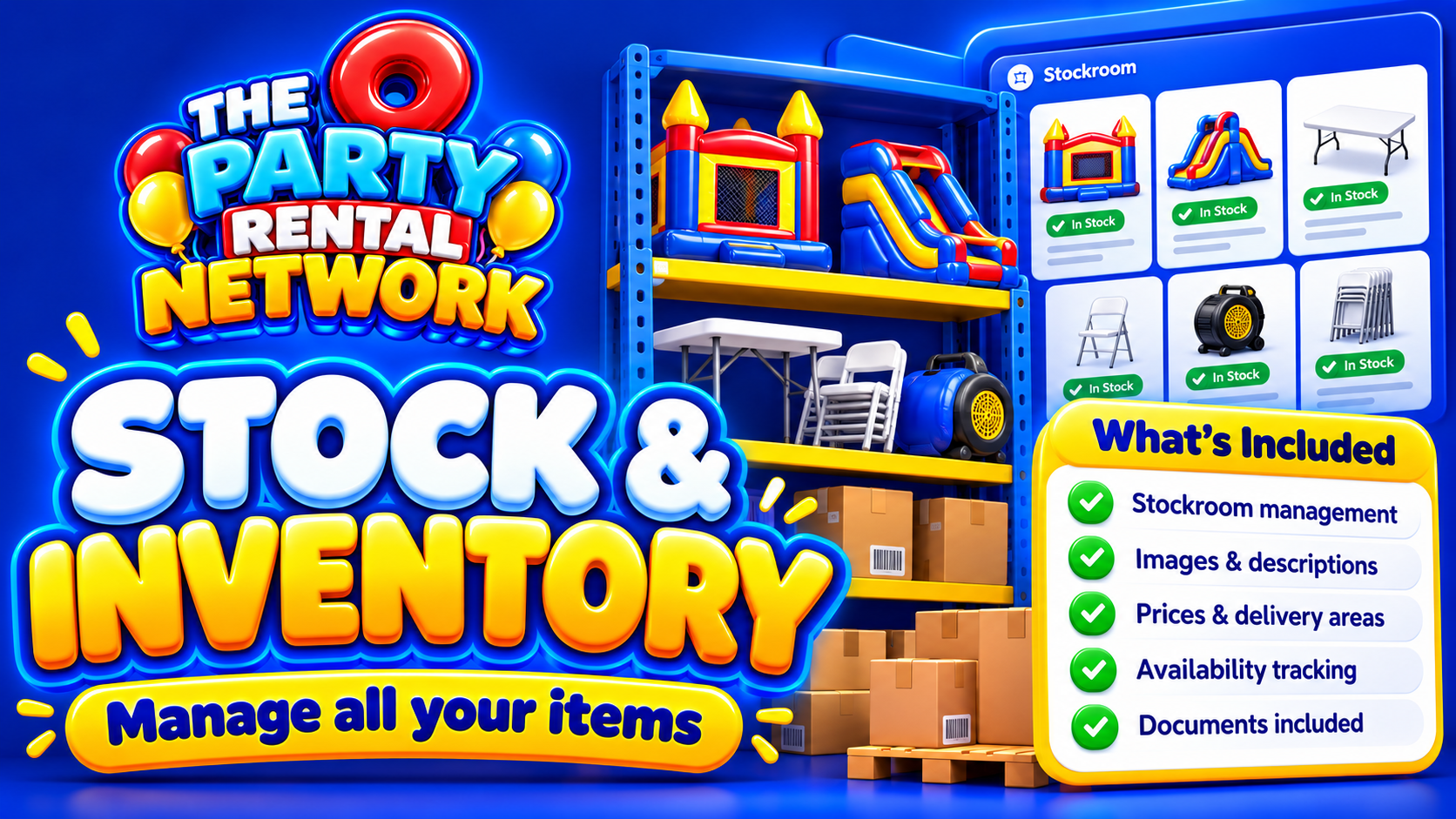
Use the Stock & Inventory feature information to assess the equipment stockroom against your fleet. Before importing records, decide how you will represent sets, spares and consumables rather than assuming every item belongs in the same structure.
Make availability cover the whole hire cycle
An event date is only part of an equipment commitment. Preparation, loading, outward travel, collection and turnaround can all prevent stock being used elsewhere. A Monday return does not necessarily make equipment ready for a Monday dispatch.
Consider an illustrative weekend: one marquee booking finishes on Sunday evening, while another requires an early Monday installation. The apparent gap disappears if dismantling, drying and inspection cannot fit between them. Availability decisions need that operational context, not just non-overlapping customer dates.
When reviewing Online Bookings, establish how booking information reaches the person allocating stock. Decide when a provisional enquiry becomes a stock commitment and who can approve exceptions. Do not let different teams apply different meanings to “reserved”.
Separate returned stock from ready stock
A return is a handover, not proof of readiness. Wet fabric, missing cables and damaged fittings can make physically present equipment unavailable for its next hire.
Create a clear return-check routine with an accountable person. Record what came back, what is missing and whether the item needs cleaning, drying, repair or further assessment. Keep unresolved equipment out of the ready-to-hire count until the appropriate checks are complete.
The Party Rental Network includes repairs and wet-equipment tools alongside its equipment stockroom. Establish how your team will use those tools in its return workflow. A recorded status supports coordination; it does not certify equipment or replace competent inspection and any required safety documentation.
Reconcile the stockroom with the loading plan
Inventory promises also have a transport consequence. A booking can be fully covered by stock and still be difficult to fulfil if bulky equipment cannot fit alongside the rest of that day's load.
The platform's Route Planning & Loading features cover transport planning and 3D van loading. Use transport planning alongside stock allocation, particularly when collections and deliveries share a vehicle.
Define checks at picking, dispatch and return so substitutions and shortages reach the booking team. Route and driver planning should not be confused with live GPS vehicle tracking; they address different operational questions.
Choose software around your working system
Your inventory system is the combination of records, responsibilities and rules. Software supports that system. Buying a tool before agreeing who changes stock status can simply move an inconsistent spreadsheet process into a dashboard.
Test a realistic job before committing to a setup: a package booking, a damaged component, a replacement and a delayed collection. Ask which steps are supported directly, which need manual checks and what permissions staff require. Confirm package inclusions rather than assuming every tool is included.
For a focused demo, bring a small sample of your stock records and one troublesome turnaround scenario. That makes suitability easier to judge than a tour of unrelated features.
Questions about event hire inventory management
Can a spreadsheet still be useful?
Yes, particularly for a small, straightforward fleet. Its limitations become more significant when several people update bookings, condition and returns separately. Assess whether everyone can identify the current record and trace changes reliably.
Should every item have its own identifier?
Not necessarily. Track interchangeable items by quantity where appropriate. Individual identifiers become useful when condition, maintenance, documentation or value needs to be associated with a specific piece of equipment.
How should hired-in equipment be recorded?
Keep it distinguishable from owned stock. Record the supplier, agreed availability, collection arrangements and return deadline. Otherwise a temporary addition can accidentally become part of your normal available quantity.
How often should physical stock be checked?
Base checks on movement and risk. Frequently hired accessories may need closer reconciliation than rarely moved equipment. Investigate discrepancies promptly instead of waiting for an annual count to explain recurring shortages.
Is a free network account the same as paid inventory software?
No. Free network accounts can list equipment and become eligible for opportunities, without guaranteed bookings. Paid subscriptions provide business tools according to package. Check the included inventory capabilities before choosing a subscription.
What should be prepared before moving records?
Remove duplicates, standardise names and reconcile quantities. Separate unavailable equipment from ready stock, identify incomplete sets and agree who owns future updates. A tidy starting record is more useful than importing every historic inconsistency.