Inflatable damage tracking software

What Is The Party Rental Network?
A connected booking, website and AI-powered business platform built around party rentals and event hire, with tools for your equipment, customers, team and wider industry network.
What Type of Party Rental Business Do You Run?
Equipment records, safety documents, delivery planning and artwork tools help keep inflatable hire jobs organised.
A castle can be back in the warehouse without being ready for its next garden. That gap between physical return and hire readiness is where damage tracking matters. A torn anchor point, suspect seam or damp pack-away needs a clear decision, not just a message buried in a staff chat.
Inflatable damage tracking software should connect each concern to the correct unit, its repair history and the bookings that might be affected. Party Rental Network includes an equipment stockroom and repairs/wet-equipment tools. When assessing its suitability, start with your damage workflow and confirm which recording and availability controls your chosen package supports.
See what's possible
Track the unit, not just the castle design
Two inflatables with the same artwork can have different histories. Give each physical unit a stable identifier before importing stock or setting up records. A description such as “blue castle” becomes unreliable when you add another, change its photograph or replace a transport bag.
Keep observations specific to the component involved: inflatable fabric, anchor point, blower, cable or accessory. An illustrative return might reveal a damaged blower casing while the inflatable itself appears unaffected. Recording only “castle damaged” leaves the next person guessing what needs attention.
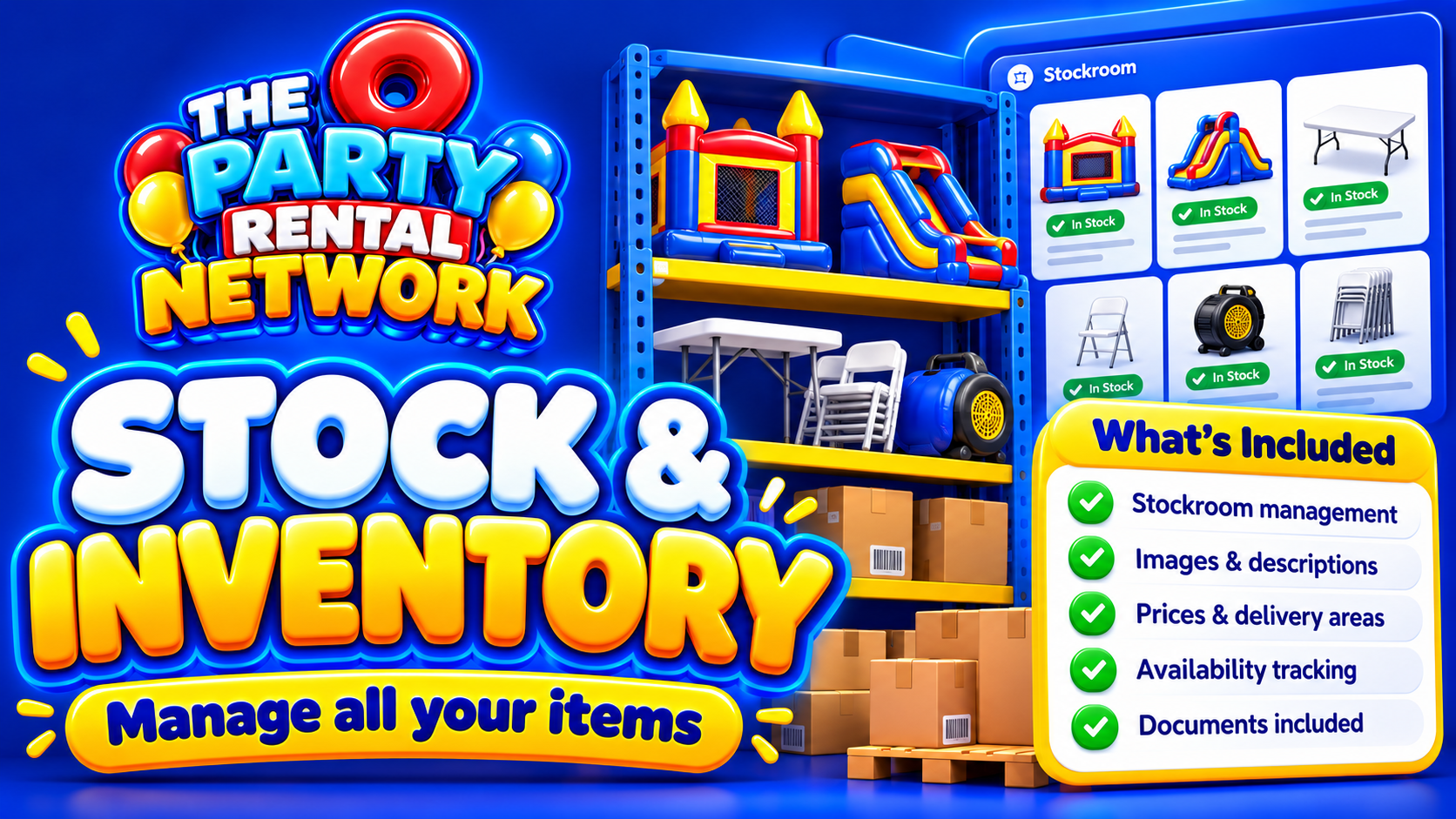
Use Stock & Inventory as the starting point for exploring how equipment records fit your operation. Check how individual units and associated accessories are represented before committing to a record structure.
Capture evidence that supports a decision
A useful report explains what was observed, when it was noticed and who recorded it. Separate the observation from its suspected cause. “Seam opening visible near entrance” is more useful than an unsupported conclusion that a customer caused damage.
When comparing software, ask whether it supports photographs, dated notes, attachments and a traceable history of changes. These are selection criteria, not assumptions that every package includes every capability. Establish an agreed place for supporting evidence if your chosen setup uses separate documents.
Collection, cleaning and inflation checks can reveal different issues. Recording the discovery stage helps staff understand the sequence without turning a damage report into an automatic liability judgement.
Separate wet equipment from damage and clearance
Wet equipment needs attention, but wet does not automatically mean damaged. Equally, a dry inflatable is not necessarily ready to hire. Treat drying, repair work and release for use as separate decisions in your operating procedure.
Party Rental Network includes repairs/wet-equipment tools. During setup, confirm how those tools represent your preferred statuses and whether any status changes affect booking availability automatically. Do not assume that a repair note alone prevents another booking.
Define who can report a concern, who arranges the next action and who authorises release under your inspection arrangements. Software can retain information and support handovers; it cannot certify an inflatable or replace competent inspection and qualified safety advice.
Check the next booking before the next load
Damage becomes an urgent operational problem when the affected unit is promised again tomorrow. Your procedure should include checking forthcoming commitments as soon as a concern is recorded, rather than waiting until loading begins.
Explore Route Planning & Loading alongside equipment records to understand how transport planning fits that handover. Confirm whether a stock-status change flows through to loading information or requires a manual update.
If a substitution is needed, check suitability, availability and customer agreement. The Party rental booking exchange is relevant when exploring network opportunities, but replacement equipment or supplier availability must never be assumed.
Choose software around a testable workflow
A damage tracking system includes staff responsibilities and operating rules. Software is the practical tool that must make those rules workable. Selection therefore needs more than a screen showing an open repair.
Test one illustrative journey: identify a unit, record a concern, check upcoming hires, arrange attention and document the release decision. Ask about permissions, evidence storage, record export and duplicate assets. Confirm what works on staff devices and which steps require connectivity; backup copies do not establish offline operation.
Review Business Tools and Event rental booking software to assess the wider fit without losing sight of that damage journey.
Understand free access and paid tools
Free Party Rental Network accounts can list equipment and become eligible for opportunities. Paid subscriptions provide business tools according to package. Free membership should not be interpreted as including every repair-management capability, and neither access level guarantees bookings or income.
Before you join the network, establish which tools you need. You can book a demo to verify the damage workflow and package coverage rather than relying on a feature name alone.
Questions about inflatable damage tracking software
Can I record existing damage before a hire?
Make pre-hire condition recording part of your procedure. Confirm how your selected software stores dated observations and any supporting evidence against the correct unit.
Should every scuff stop an inflatable being hired?
Not every observation has the same significance. Follow your inspection arrangements and obtain competent advice where needed; software should not make unsupported safety judgements.
Does recording damage automatically block bookings?
Do not assume so. Verify the relationship between repair status and availability, then assign responsibility for any manual booking checks.
Can damage records establish customer liability?
They can support a factual account, but a record alone does not establish liability. Consider the evidence, agreed terms and appropriate legal advice.
What should happen after a repair?
Document the work and the required inspection or release decision. Closing an administrative task is not, by itself, evidence that equipment is safe.
Can I bring across old repair notes?
Ask about available import options. First match historical notes to stable equipment identifiers and flag uncertain entries rather than presenting incomplete history as verified fact.