How to Start a Bouncy Castle Company
Launching an inflatable hire business in the United Kingdom offers an attractive commercial opportunity for driven entrepreneurs. The demand for commercial inflatables across domestic birthday parties, school fairs, corporate family days, and community festivals remains resilient throughout the warmer seasons and transitions into indoor hall venues across the winter months. However, turning a passion for event entertainment into a sustainable, profitable venture demands far more than merely purchasing a unit and a second-hand transport van. Success hinges on a clear operational framework, uncompromising safety standards, and robust business administrative systems from day one.
Prospective operators must navigate equipment procurement, regulatory compliance, transport logistics, and competitive marketing in their chosen operational territories. By approaching the venture with formal commercial disciplines rather than treating it as a casual weekend hobby, you can establish healthy profit margins and build long-term local enterprise equity. This guide details the foundational steps required to launch a compliant, customer-focused bouncy castle business in the UK, while highlighting how dedicated technology streamlines everyday administrative burdens.
See what's possible
Business Benefits
Operating an inflatable hire company delivers significant flexibility, offering either a lucrative weekend supplemental income or the operational base for a full-time equipment rental fleet. With a relatively low barrier to entry compared with retail or hospitality franchises, an operator can start small with two or three versatile units and scale the fleet organically from retained operational revenue. Cash collection cycles are uniquely favourable because hire companies typically collect deposits during reservation and full balances prior to or upon delivery, keeping trade receivables low and operating cash flow positive.
Furthermore, the business model benefits from strong local repeat business and community word-of-mouth recommendations. A child who enjoys an inflatable at a classmate party often requests the same supplier for their own celebration, creating organic seasonal compounding. As your reputation for reliability, safety, and hygiene grows, you can expand service offerings into soft play, obstacle courses, garden games, and seasonal event packages, maximising the revenue generated from every customer relationship.
How Party Rental Network Helps
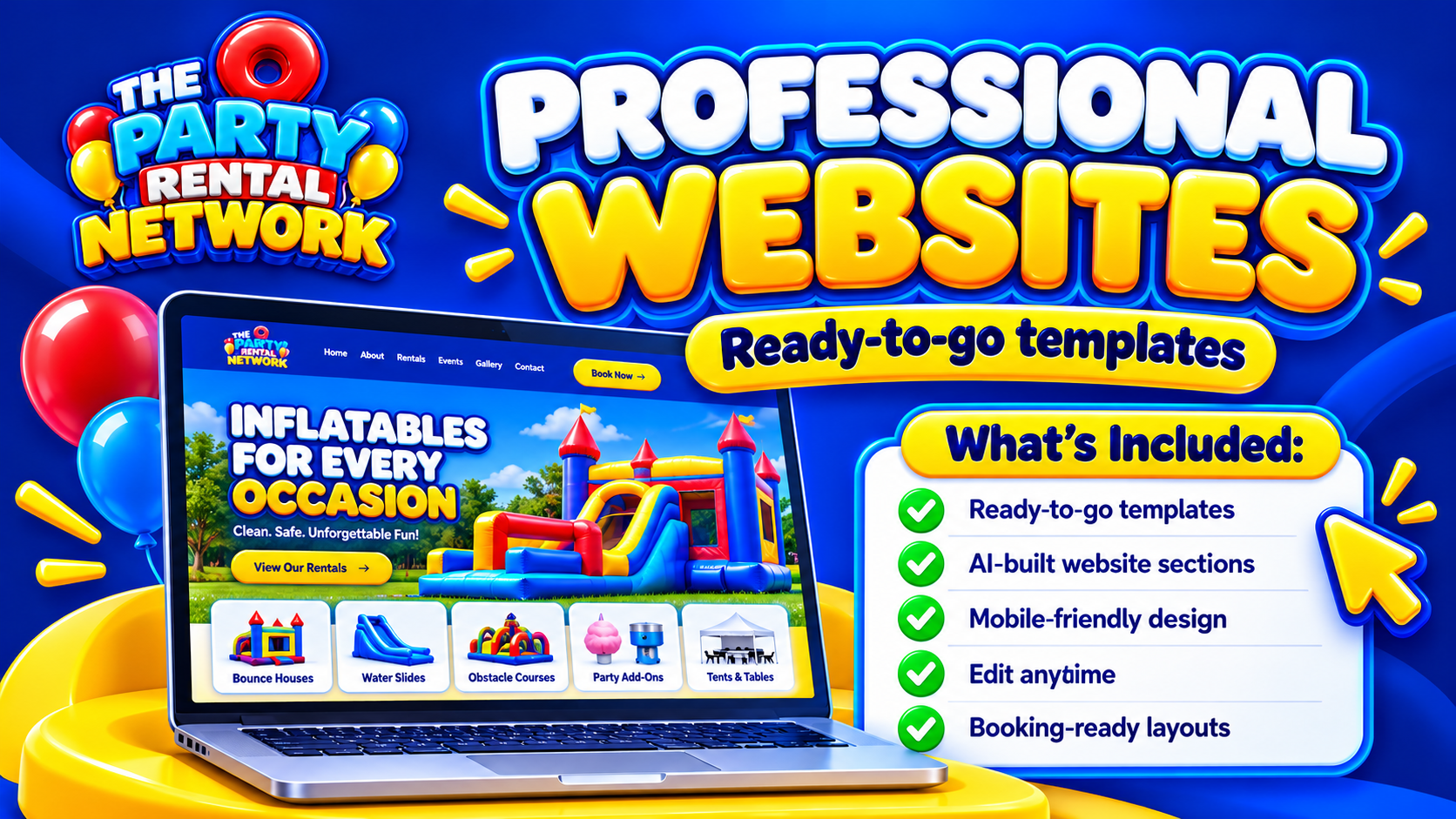
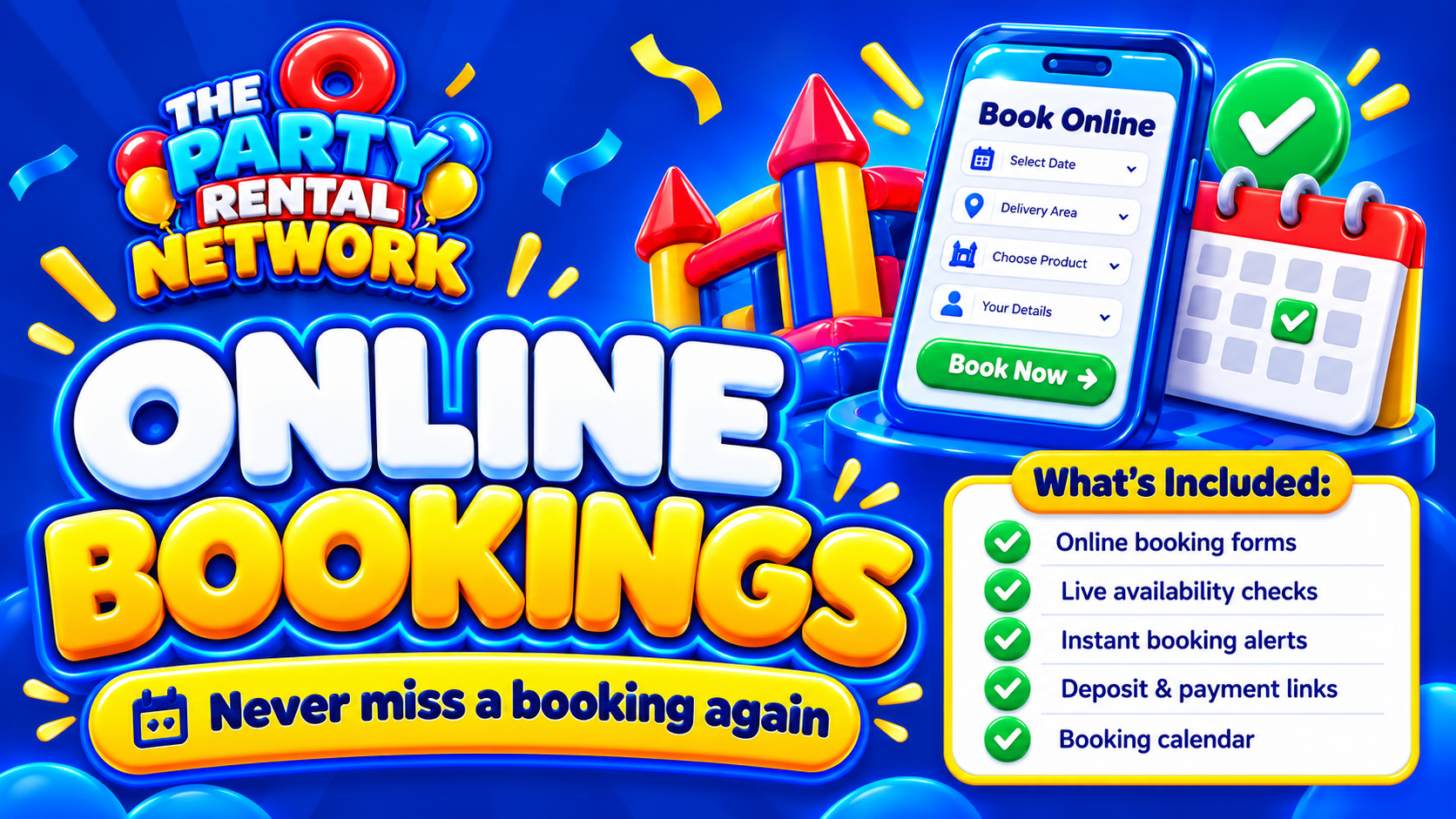
Managing incoming enquiries, manual diary coordination, customer invoicing, and equipment availability by hand rapidly leads to double-bookings and administrative fatigue. Party Rental Network resolves these friction points by providing an all-in-one commercial platform engineered specifically for UK inflatable hire businesses. With purpose-built bouncy castle booking software, operators receive a customer-facing digital storefront where private clients and corporate coordinators can check dynamic real-time availability, select delivery windows, and submit bookings around the clock.
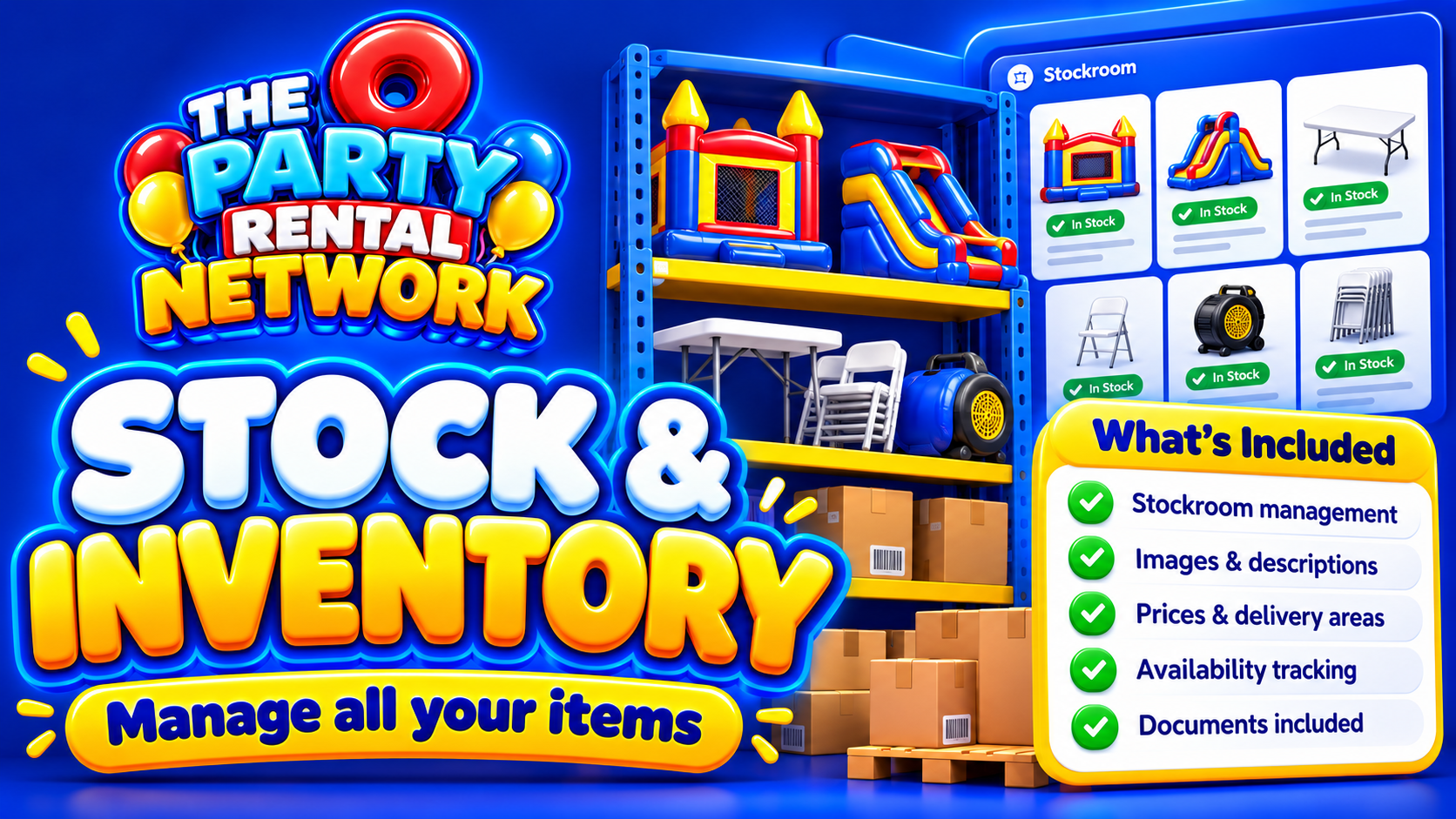
Behind the scenes, Party Rental Network manages complex logistical demands without spreadsheets or paper diaries. Operators utilise dynamic stock inventory tracking to prevent unit conflicts, while integrated route planning and van loading tools sequence drops and pick-ups to minimise driver transit hours and vehicle fuel consumption. Built-in payment systems automatically balance customer accounts, while Yodo, the embedded AI booking assistant, responds intelligently to customer queries. You can explore how these components integrate within your business operations by choosing to book a demo with our team.
Equipment Sourcing, Safety and British Standards
Commercial inflatables must meet rigorous engineering specifications to withstand repeated public usage. When purchasing equipment, avoid uncertified imports or lightweight domestic units sold by general retailers, as they lack the tensile strength and design redundancies demanded by commercial hire. In the UK, commercial bouncy castles must comply with British Standard BS EN 14960, which governs inflatable play equipment design, manufacturing, anchoring points, and operational parameters. Reputable UK manufacturers build units using heavy-duty PVC and provide initial testing documentation.
Annual testing is mandatory for commercial operation. You must arrange for an independent, competent inspector, typically registered under the PIPA scheme or the Register of Play Inspectors International (RPII), to conduct a thorough safety audit and issue a valid certification tag. Operators are responsible for inspecting ground surfaces, verifying that blowers, anchor stakes, and impact mats are in pristine working condition, and generating thorough safety documents via party rental risk assessment software for every deployment.
Alongside equipment compliance, securing adequate insurance is essential before accepting your initial client deposit. Public liability insurance protects your enterprise against third-party personal injury or property damage claims arising from operational negligence. While standard market coverage limits commonly span from one million pounds to five million pounds depending on the venue specifications of your clients, operators should always obtain current, bespoke insurance quotes and verify policy exclusions directly with a specialist commercial broker.
Financial Planning and Initial Investment
Accurate financial forecasting prevents new operators from running short of working capital during early trading months. For an illustrative starting enterprise deploying three commercial bouncy castles, initial capital outlays generally encompass certified commercial units, high-output inflation fans, anchorage stakes, sandbags for indoor anchoring, commercial safety mats, and heavy-duty extension cables. Operators must also budget for an appropriate commercial panel van, essential branding, website development, safety training courses, and initial insurance cover.
To consider an illustrative financial example, an operator might acquire three versatile commercial units at an illustrative cost of two thousand pounds each, plus transport and insurance costs, resulting in an illustrative initial investment around ten thousand pounds. If each unit hires out at an illustrative weekend rate of ninety pounds, and each unit achieves twenty hires per season, the fleet generates five thousand four hundred pounds in gross seasonal revenue. Operating profit then depends directly upon individual overheads, fuel pricing, storage fees, routine maintenance costs, and advertising outlays. Readers must research their local regional hire pricing, source real supplier quotations, and establish conservative projections suitable for their personal tax and financial situation.
Careful control of variable operating expenditure accelerates financial break-even points. Routine cleaning products, vinyl repair kits, testing fees, and vehicle road tax accumulate over an operational financial year. Establishing a ring-fenced bank account to accumulate equipment depreciation funds ensures your business has capital on hand to replace aged inflatables every three to five years, preserving your brand reputation for immaculate, modern stock.
Transport, Logistics and Operational Workflow
Flawless delivery logistics separate market-leading hire businesses from struggling operators. Inflatable units are bulky, heavy pieces of equipment that can weigh between seventy and one hundred and fifty kilograms each, requiring heavy-duty sack trucks and safe manual handling techniques. Van load planning requires systematic staging so that inflatables needed for early deliveries are unloaded first, while units reserved for collection later in the day remain securely strapped and balanced over the axle positions.
Weekend delivery schedules often condense drop-offs into narrow morning windows between seven and ten o'clock, with collections occurring during late afternoon. Efficient scheduling requires geographical clustering, preventing drivers from criss-crossing delivery territories. Modern routing solutions help operators avoid costly delays caused by traffic congestion, allowing prompt arrival at venue locations where clients have limited indoor hall access times.
Collection routines demand equal attention to hygiene and condition monitoring. Upon collecting units from domestic gardens or event venues, staff must inspect the vinyl for tears, missing anchor tags, or heavy contamination. Implementing systematic check-in routines ensures that inflatables are dried thoroughly prior to storage, preventing mildew formation and extending the lifespan of your capital investment.
Marketing, Local Search and Booking Conversions
Attracting local party planners requires strong online visibility within your designated service radiuses. Parents and event organisers frequently search search engines using territorial keywords like party equipment hire, bouncy castle hire near me, or local indoor soft play hire. Having a fast, mobile-optimised web presence built around SEO for bouncy castle businesses helps capture high-intent search queries ahead of competing local hire services.
Digital marketing activities should be complemented by proactive community engagement. Building relationships with local school parent-teacher associations, wedding planners, community centre custodians, and sports clubs yields regular recurring commercial hires. Providing clear safety paperwork, prompt communication, and spotless equipment creates a lasting professional impression that translates into referrals across neighbourhood social platforms and parent networks.
Finally, the conversion rate from website visitor to paid booking depends heavily upon checkout ease. Modern consumers expect frictionless e-commerce interactions rather than back-and-forth email exchanges. Clear equipment photography, accurate dimensions, power requirements, and instant payment validation empower visitors to confirm reservations swiftly, converting casual interest into secured weekend revenue.
Frequently Asked Questions
Do I need a specific licence to operate a bouncy castle business in the UK?
While you do not generally require a statutory local authority operating licence simply to hire bouncy castles out on private property, you must comply fully with UK health and safety legislation, including the Health and Safety at Work etc. Act 1974 and the Provision and Use of Work Equipment Regulations. If you intend to operate equipment on public parkland or council-controlled property, you must obtain prior written consent from the relevant local authority and show current proof of public liability insurance and annual safety inspection certificates.
What safety testing is required for commercial inflatables in the UK?
Commercial inflatables used for jumping or sliding are required under UK health and safety regulations to undergo a comprehensive annual inspection by a competent person, ensuring ongoing compliance with the BS EN 14960 standard. The PIPA scheme and the RPII provide independent qualification frameworks for inspection engineers who evaluate structural integrity, seams, anchorage point strength, and blower performance before issuing a recognized certification tag, which must be retained in your operational records.
What vehicle do I need to start an inflatable hire company?
Most operators begin by using a medium or long-wheelbase commercial panel van such as a Ford Transit, Vauxhall Vivaro, or Mercedes-Benz Vito, which provides the necessary payload capacity and rear cargo volume to transport several rolled inflatables alongside safety mats, blowers, and heavy-duty hand trucks. You must always check your vehicle manufacturer gross vehicle weight ratings and payload limits to ensure that carrying several commercial inflatables and peripheral accessories does not exceed legal payload thresholds.
Can bouncy castles be operated outdoors in rainy or windy weather?
Inflatables must never be operated outdoors in wind speeds or gusts exceeding the maximum operational limit specified by the manufacturer, which under BS EN 14960 is strictly twenty-four miles per hour (thirty-eight kilometres per hour). Operators must carry a calibrated anemometer on all delivery vans to measure local wind conditions directly on site. In wet conditions, wet vinyl poses significant slip hazards, and electrical inflation blowers must be protected with commercial waterproof covers and connected via residual current devices.
How much public liability insurance cover do I need?
Public liability coverage requirements depend on the types of venues and clients you service, with most UK insurers offering policies starting at one million pounds and rising to five or ten million pounds of indemnity. Many local councils, corporate event organisers, and indoor community venues mandate a minimum of five million pounds of public liability insurance before granting permission to set up equipment on their grounds, meaning you should consult a specialist broker to select a policy aligned with your target venue profile.
What steps are required to manage indoor bookings during the winter months?
Operating indoor hires through colder autumn and winter months requires checking the internal dimensions of local village halls, church halls, and sports centres to ensure adequate ceiling height clearance for the units you intend to supply. In addition, when setting up on hard indoor flooring, you cannot drive ground stakes, so you must secure inflatables using manufacturer-specified sandbag anchor weights alongside extensive safety matting around all exposed entrance and exit surfaces.
Helping Party Rental Businesses Across the UK
England: London | Birmingham | Manchester | Liverpool | Leeds | Sheffield | Bristol | Nottingham | Leicester | Coventry | Bradford | Newcastle upon Tyne | Southampton | Portsmouth | Plymouth | Derby | Wolverhampton | Stoke-on-Trent | Norwich | Oxford | Cambridge | York | Peterborough | Sunderland | Brighton and Hove | Milton Keynes | Preston | Hull | Gloucester | Exeter | Bath | Chester | Carlisle | Durham | Lancaster | Lincoln | Worcester | Hereford | Canterbury | Winchester | Chelmsford | Colchester | Southend-on-Sea | Salford | Wakefield | Doncaster | Westminster | St Albans | Salisbury | Chichester | Truro | Wells | Ripon | Ely | Lichfield
Wales: Cardiff | Swansea | Newport | Wrexham | Bangor | St Asaph | St Davids
Scotland: Glasgow | Edinburgh | Aberdeen | Dundee | Inverness | Stirling | Perth | Dunfermline
Northern Ireland: Belfast | Derry/Londonderry | Lisburn | Newry | Armagh | Bangor (County Down)